
Frequently asked questions

Here you will find answers to the most frequently asked questions about BEAM CUBE, its solutions, its technology and its approach. Is a question missing? Our team will answer you directly via the contact page.

BEAM CUBE and the approach

BEAM CUBE is a French company founded in 2016 in Vannes, in Brittany. It designs activity virtual twins to transform industrial organizations, construction players and territories. A Dassault Systèmes Experience Provider Partner and winner of the EIC Innovation Award 2023, BEAM CUBE presented its work at COP29 and COP30 under the aegis of the European Commission and the United Nations (UNFCCC). The company employs around ten people and relies on Dassault Systèmes' 3DEXPERIENCE to build its solutions.

BEAM CUBE supports organizations that are transforming their activity, their assets or their territory. Our clients are manufacturers (manufacturing, industrial processing), construction players (project owners, contractors, engineering firms, architects, industry manufacturers), organizations steering innovation, site operators (industrial, hospital, university), local authorities, and public or private real estate asset managers. Our references include Bouygues Construction, VINCI Construction Grands Projets, Airbus, Piveteau Bois, École Polytechnique, Artelia, Naval Group, Woodeum, and local authorities such as Reims, Lorient and Vannes.

Our solutions adapt to different scales. We work with large international groups transforming their industrial processes across several sites, with public organizations steering an entire estate or territory, and with mid-caps or intermediate organizations industrializing their value chain. What our clients have in common is not size, but the nature of the project: a transformation challenge around rationalizing and showcasing their know-how, business continuity, or steering at the scale of a complex system.

Our teams are based in France, in Vannes, and our engagements today are mainly concentrated in France and Europe. But our approach is carried at the European scale and beyond, through our work within the High-Level Construction Forum (European Commission, DG GROW), the Industry 5.0 Community of Practice (DG RTD), GlobalABC (UN Environment Programme), and our presentations at COP29 and COP30. For multi-country or international projects, contact our team directly.

A consulting firm generally delivers recommendations in document form, leaving the client to implement them. BEAM CUBE delivers operational solutions embedded in a complete technological solution that transforms teams' daily work. Our project managers support their clients from initial framing to go-live, keeping control of the overall consistency between business analysis and technical deployment.

The Solutions EVID3NCE_FOR and REGEN3TIQ_FOR

An activity virtual twin is a living virtual representation of a real system: an activity, a site, a territory, an asset portfolio. Unlike a simple digital mock-up limited to a geometric representation, an activity virtual twin also — and above all — integrates the system's data, its processes and its business rules, and lets its users simulate, predict and steer continuously. It is a living virtual replica of a system, able to learn, simulate scenarios and guide decisions; like a GPS that constantly recalculates the best route in real time.

This is the definition carried by BEAM CUBE, which goes beyond the narrower notions of the "digital twin" found in the scientific literature.
There are several digital representations of the real world:
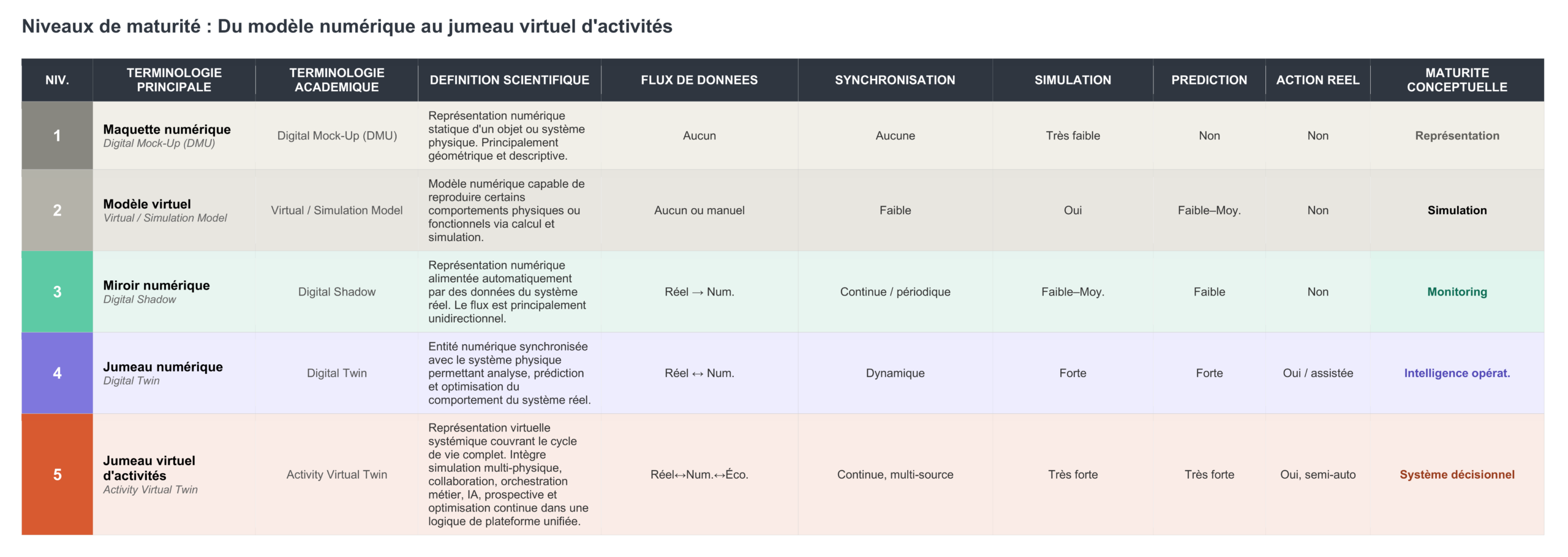
With EVID3NCE_FOR and REGEN3TIQ_FOR, BEAM CUBE deploys solutions positioned at the most advanced level: the activity virtual twin. Where the scientific literature often stops at the digital twin, our solutions go one step further: coverage of the full lifecycle, business orchestration, AI integration, continuous optimization in a unified platform logic.

It is this broadened definition that we carry in our European work and that structures our offer.

The two solutions address two complementary dimensions of activity; both are virtual twins.

The first serves those who create value: manufacturers who produce, construction players who design and build, organizations steering innovation. From quote to delivery, from laboratory to prototype, from construction site to handover.

REGEN3TIQ_FOR is the virtual twin dedicated to renovation, management, operations and maintenance. It serves those who own assets and wish to reveal, harness and extend their value: owners of operating sites, local authorities administering a territory, and managers of real estate asset portfolios.

The two solutions rely on the same technological foundation and can talk to each other. Producers and owners thus share a common digital reference, from the first pencil stroke to predictive maintenance.

Yes — it is even one of the strengths of our architecture. Both solutions rest on the same 3DEXPERIENCE technological foundation, which allows a client who both owns and produces (a manufacturer who owns its site, a project owner building its own estate) to benefit from complete digital continuity, from the first quote to the predictive maintenance of the delivered asset. This articulation is framed upstream of deployment, as part of a dedicated consulting engagement.

No. BIM (Building Information Modeling) is an approach that aims to structure and share the data of a construction project, mainly during the design and construction phases.
Our solutions go further. EVID3NCE_FOR extends the logic of BIM by integrating business processes, sales management, the supply chain and data governance, while broadening it to fields beyond building, such as industry and innovation. REGEN3TIQ_FOR then takes over during the operations, maintenance, renovation and asset management phases — dimensions generally little or not covered by BIM.
An existing BIM model can moreover be integrated into our solutions and become one of their data sources, alongside other systems such as ERPs, EDM, GIS or connected devices.

Not exactly. An ERP (Enterprise Resource Planning) system drives the company's management processes (purchasing, sales, finance, human resources, production, etc.), while a PLM (Product Lifecycle Management) solution manages the data and processes related to a product's lifecycle, from design to end of life.

EVID3NCE_FOR and REGEN3TIQ_FOR are built on Dassault Systèmes' 3DEXPERIENCE platform, whose PLM capabilities are one of their technological foundations. As such, our solutions can take on all or part of the functions traditionally covered by a PLM.

Beyond these capabilities, they federate and structure data from multiple sources (ERP, BIM, GIS, EDM, IoT, CRM, etc.) within a common digital repository guaranteeing the continuity, consistency and traceability of information throughout business processes.

Depending on the organization's needs, the custom developments, business applications and widgets we design can also cover certain functions usually handled by an ERP. This approach makes it possible to offer more targeted tools better suited to users' real practices, where traditional ERPs can sometimes carry a broader functional scope than necessary.

The 3DEXPERIENCE technology and data storage sovereignty

3DEXPERIENCE is a collaborative digital platform developed by Dassault Systèmes. It centralizes, structures and shares an organization's data, processes and knowledge within a single, secure environment. It can be seen as a next-generation CDE (Common Data Environment), that is, a common data environment allowing all stakeholders to access single, consistent, controlled information. Initially designed to meet the needs of industry, it notably integrates product lifecycle management (PLM), 3D modeling, simulation, document management, collaboration and data governance capabilities. Its flexibility, however, allows it to be adapted to many sectors beyond the industrial world. BEAM CUBE builds on this technological foundation to develop EVID3NCE_FOR and REGEN3TIQ_FOR. Our teams configure the platform, model business data and processes, then develop applications, dashboards and specific components to meet each client's operational needs. The 3DEXPERIENCE platform is thus the technological engine of our solutions, while EVID3NCE_FOR and REGEN3TIQ_FOR provide the business models, methods, management rules and practices that turn this technology into a true operational virtual twin.
A CDE (Common Data Environment) is a structured digital space for centralizing, managing and sharing all the information of a project or asset throughout its lifecycle. It aims to ensure that all stakeholders work from single, consistent, up-to-date and traceable data, according to their access rights. The CDE is not just a storage space: it organizes information flows (creation, validation, distribution, archiving), secures exchanges and ensures data traceability between stakeholders. Dassault Systèmes' 3DEXPERIENCE platform, on which BEAM CUBE's solutions are built, can be used as the foundation of an extended CDE, thanks to its data, process and access rights management capabilities. It is then enriched by the business layers and specific processes deployed in EVID3NCE_FOR and REGEN3TIQ_FOR, to adapt this common environment to each organization's operational practices.

Our clients' data is hosted on a cloud infrastructure operated by Dassault Systèmes, designed to meet high security and data protection requirements.

Depending on the environments and the client's needs, this infrastructure can be deployed on offers qualified SecNumCloud by ANSSI or on environments compliant with European data protection standards, notably the GDPR. These arrangements offer a high level of security, confidentiality and availability.

They aim to guarantee a data management framework controlled under European contractual and legal terms, with strengthened requirements for sovereignty, resilience and service continuity. They also help strictly govern the conditions of data access and processing, and limit exposure to non-European jurisdictions.

SecNumCloud is a security qualification issued by the French national cybersecurity agency (ANSSI). It attests that a cloud service meets a very strict set of requirements for security, data protection, resilience and sovereignty. This qualification aims to guarantee a high level of risk control, notably over hosting, operations and data access, within a framework compliant with the most demanding security standards in Europe. In practice, SecNumCloud is particularly sought after — and sometimes required — for public administrations, operators of vital importance and organizations handling sensitive or strategic data. In these contexts, it becomes a de facto reference standard, even a near-mandatory requirement in calls for tenders and compliance practices. The fact that the EVID3NCE_FOR and REGEN3TIQ_FOR solutions rest on a SecNumCloud-qualified infrastructure makes them suitable for environments subject to strong security, sovereignty and regulatory compliance constraints.
Yes, unambiguously. The data you load, create or generate in EVID3NCE_FOR and REGEN3TIQ_FOR belongs fully to you. BEAM CUBE and Dassault Systèmes act solely as technical service providers, without acquiring any ownership rights over your business content. All contractual terms strictly govern these principles, notably guaranteeing data control, portability and reversibility. These provisions ensure that you retain full sovereignty over your data, including if you change solution or provider.

Deployment and support

The duration of a BEAM CUBE deployment depends on the scope, the number of users and the level of transformation involved. An exploratory framing phase can be carried out in a few weeks to define the objectives, the data to integrate and the processes to model. Then, deploying a solution such as EVID3NCE_FOR or REGEN3TIQ_FOR on a targeted business scope generally takes a few months. The implementation pace is adapted to the client's operational context, with a progressive approach that secures data integration, user adoption and the business value generated. The initial framing phase thus establishes a realistic timeline aligned with the organization's constraints.
No. The goal is precisely to avoid any interruption of activity. EVID3NCE_FOR and REGEN3TIQ_FOR are deployed out of cycle, in parallel with your existing tools and processes, until they reach a sufficient level of operational maturity. During this phase, the solution is progressively configured, enriched and tested on real scopes, without disturbing existing practices. Once stabilized and validated, it can progressively take over from existing systems, through gradual switchover or controlled coexistence depending on the use cases. This approach guarantees a secure, seamless transition, suited to critical environments and complex organizations.

Change management is built into the approach from the framing phase. It involves operational teams at the key stages of deployment, provides training adapted to the different user profiles, and supports skill development over time.

Beyond the technical aspects, the challenge is also organizational and cultural: moving from a siloed organization to a collaborative, shared environment requires structured support, carried jointly by the project teams and the business champions.

This dimension is decisive in the success of any digital transformation. It is therefore addressed systematically and rigorously in all our deployments, to secure user adoption and ownership of the solutions.

Training is tailor-made, according to user profiles and their practices.

An executive who consults indicators and steers the activity does not have the same needs as an operational user who enters or uses data daily, nor as an administrator in charge of configuration and rights management.

Sessions are delivered by the BEAM CUBE teams, on-site or remotely depending on the context, and adapted to organizations' operational constraints. They can also be structured as lasting reference modules to make onboarding new users easier over time.

After go-live, BEAM CUBE remains present through ongoing maintenance and evolution support.

Your teams have a dedicated point of contact for technical and functional matters, handling day-to-day requests as well as adjustment or improvement needs.

Beyond corrective maintenance, platform evolutions, adaptations to organizational changes and functional enrichments are part of a continuous dynamic. This approach aims to evolve the solution in line with real practices and business transformations, in a lasting relationship with your teams.

Commercial and institutional questions

Yes, BEAM CUBE can work within public procurement frameworks and respond to standard consultation procedures.

In certain cases and depending on the applicable public procurement schemes, notably for innovation or R&D services, it may also be possible to contract directly with BEAM CUBE without a formal competitive tendering process for amounts up to €100,000, in accordance with the rules in force.

This flexibility is a useful lever for local authorities, public institutions and administrations wishing to quickly launch an exploratory phase, a framing study or a prototype, before a more structured deployment under an adapted or formalized procedure.

In all cases, our engagements strictly comply with the legal framework of public procurement.

The Bpifrance R&D Innovation Loan is a financing scheme designed to support companies in their innovation projects, following an analysis of the innovative nature of their technological or methodological developments.

For BEAM CUBE, this scheme is above all an indicator of recognition of the innovation potential of the work carried out and of the company's ability to develop high-value-added solutions.

Operationally, certain public procurement schemes may, in regulated cases and under the conditions set out in the French Public Procurement Code, allow simplified contracting terms for innovation or R&D services, notably for amounts up to €100,000, without formal competitive tendering in certain use cases.

This type of framework can make it easier to launch initial exploratory phases with public-sector players, in a secure legal environment suited to innovative projects, while remaining strictly subject to the applicable public procurement rules.

Yes, BEAM CUBE is a Dassault Systèmes Experience Provider Partner for the AEC (Architecture, Engineering, Construction) and CCT (Construction, Cities & Territories) sectors.

This status reflects Dassault Systèmes' recognition of our ability to design and deploy solutions based on the 3DEXPERIENCE platform in these fields, and to adapt them to specific business practices.

It generally comes with access to the vendor's technical and methodological resources, as well as the ability to integrate, according to project needs, the platform's components and licenses into the solutions we deploy.

Is your question not in this list?

Let's talk directly. Our teams answer any specific question about your project, your context or your challenges.